
What is role play?
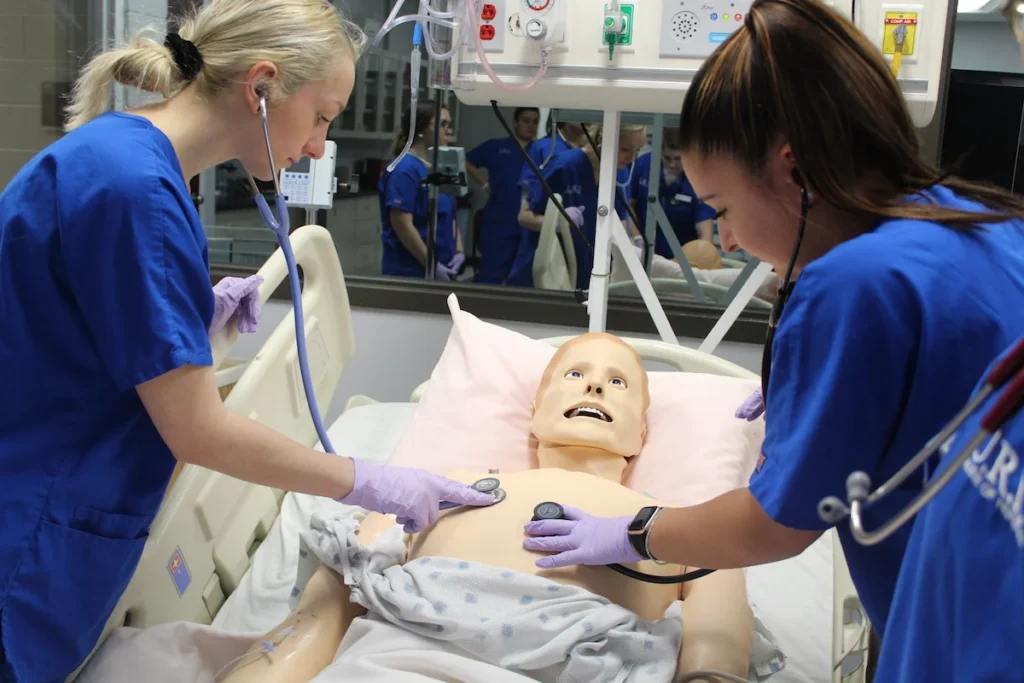
Role play is an active learning strategy where the participants act out a scenario taking on different characters (Teachers Institute, 2023), for example:
- Customer service staff dealing with a customer complaint.
- An IT help desk technician helping a participant with wifi problems get back online.
- A first aider asking a patient what their symptoms are and deciding the next steps to take.
- Law participants acting out a mock trial where multiple participants take on roles within the court system, judge, barrister, defendant, etc.
Role play can be used in many settings, both in the classroom, in a simulated environment such as a model office, online via video or in a simulated online environment (Russell and Shepherd, 2010).
Why role play?
There are many benefits to role play:
- It develops confidence in speaking and listening.
- It allows an immersive experience of a topic which develops understanding of the material or practice.
- It promotes participant engagement with subject matter.
- It is good practice developing skills for the real-world environment in a safe environment where advice can be given by an instructor or other participant observing the interaction.
Tool / Software option
There are several tools available to facilitate online role-play activities.
- Email and chat exchanges can also be utilised for role play. These can be managed through Teams with the tutor being copied into to exchanges.
- A Teams meeting along with the use of breakout rooms for participants to practice are the simplest options for role play activities.
- Blackboard provides an AI Conversation role play facility where the participant interacts with an online persona taking one of the roles.
Practical tips and considerations
Role play can be one of the most interesting and enjoyable learning experiences for both participants and tutors alike.
- Select the type of role play activity
- Simple pair role play including a swap so each participant can experience both sides of the discussion.
- A broader scenario which allows the participants to act such as a mock trial.
- Almost real-life scenario in which participants can practice applying skills and knowledge they will need for the professional careers.
- Define the objectives: Set the scene, ensure participants know the purpose and outcomes of the activity. Provide the participants with a clear written scenario, for example a member of staff has had an accident, both participants will have the same basic information.
- Structure: If the scenario requires it, provide each participant with specific instructions, for example the ‘first aider’ may have only the bear minimum i.e. ‘a member of staff has had an accident’, whereas the ‘patient’ may have more information, e.g. they have fallen down a flight of stairs and were unconscious for a short time, or even allow the participant to decide what type of accident they have had. This allows for further creativity. This may include setting a time limit.
- To observe or not: Allow the participants practice time, then if they are to be observed, make this as unobtrusive as possible to give the participants space to carry out the activity.
- Debrief: Encourage the participants to discuss the activity, include an opportunity for self-reflection and give constructive feedback.
Consider recording the role-play so the video is available for participants wishing to review their own performance or to provide peer feedback to other participants.
It can also be linked to Blooms Revised Taxonomy. Rao and Stupans (2012) outline various scenarios and how these can be used: swap role play is suitable for recall; acting enables students to apply learning and almost real-life scenarios allow students to analyse and evaluate situations thus enabling them to make decisions to resolve problems.
There are some negative things to consider:
- Participants may be nervous about the activity and are often unwilling to expose themselves in such a scenario and may feel nervous about ‘performing’. In this situation it is good to have an online option as a warm-up activity, e.g. chat or email exchange before the in-person activity.
- The role play may take an unexpected turn if the participants take the discussion in a different direction, be ready to reign them back in if necessary.
- Participants may not see the benefits of the activity and not engage with the activity with enthusiasm. What works with one group may not work with another.

Tips for accessibility and inclusion
- Ensure the brief makes clear the purpose of the task and the benefits to the participant.
- Make the roles gender neutral where possible.
- Consider the flipped classroom approach so participants have an opportunity to absorb the brief and allow time to prepare for the role play activity.
- Make the brief flexible to allow for different attitudes and approaches.
- Provide scaffolding to support participants who find the activity difficult.
Further information
How-to guide
How-to guide
Resources
References
- RAO, D. & STUPANS, I. (2012). ‘Exploring the potential of role play in higher education: development of a typology and teacher guidelines’. Innovations in Education and Teaching International [Online], 494. 427–436 Available at: https://doi.org/10.1080/14703297.2012.728879 [Accessed 18/02/2026].
- RUSSELL, C. & SHEPHERD, J. (2010). ‘Online role-play environments for higher education’. British journal of educational technology [Online], 416. 992–1002 Available at: https://bera-journals-onlinelibrary-wiley-com.ezphost.dur.ac.uk/doi/full/10.1111/j.1467-8535.2009.01048.x [Accessed 18/02/2026].
- TEACHERS INSTITUTE. (2023). ‘Learning Through Action: The Role of Role Play in Education’. Higher Education – The Psycho-Social Context [Online]. 27/12/2023. Available from: https://teachers.institute/higher-education-the-psycho-social-context/role-play-in-education/ [Accessed 18/02/2026].