

Durham recognises the power of engagement and the role of students as active participants in their education. The University commits to diverse teaching strategies beyond traditional lectures, encompassing methods like problem-based learning, collaborative projects, and flipped classrooms. This dynamic approach ensures that every class is vibrant, engaging, and conducive to deeper understanding.
Explore by topic:
Collaborative Learning
-

Brainstorming
What is brainstorming? Brainstorming is a spontaneous group activity which rapidly generates ideas without any evaluation or filtering of suggestions. Every idea suggested is documented for future consideration. The techniques of brainstorming was introduced by Alex Osborn in 1942 (Besant,…
-
Facilitating Online Discussions
What are online discussions? Online discussions are interactions which take place via platform such as a discussion board or forum, often asynchronously. They can also be synchronous, for example instant messaging or chat in Teams. Discussions can be used for…
-

Facilitating peer feedback & peer review
What is peer feedback? Peer review, or peer feedback, is a two-way process where students review each other’s work and provide constructive feedback. The task could involved students reviewing peer’s work individually, as a group or compare across or within…
-
Pedagogies for Electronic Voting Systems (Polling)
Polling allows you to gather ideas, test knowledge or canvas the opinion of a large group of students, with users responding anonymously. At Durham, Poll Everywhere is available as a Core Educational Tool. Polling software is a popular choice for anyone looking…
-

Social Annotation
What is social annotation? Social annotation refers to collaborative reading and annotation. It is a collaborative learning activity, and an alternative to setting students reading activities to engage with on their own. Typically, documents are shared and each member of…
-

Think-Pair-Share Activities
What is a think-pair-share activity? Think-Pair-Share is an activity which can be used in teaching to encourage students to talk, collaborate with fellow students and present ideas (Mundelsee & Jurkowski, 2021). Why use think-pair-share? Tool/Software option If conducting this activity…
Group Learning
-

Introducing Role Play Tasks
What is role play? Role play is an active learning strategy where the participants act out a scenario taking on different characters (Teachers Institute, 2023), for example: Role play can be used in many settings, both in the classroom, in…
Problem-Based Learning
-

Fieldwork: Learning Outside the Classroom
What is Fieldwork? Fieldwork is undertaking study away from the classroom. It is a methodology which can be used by learners and researchers across many disciplines (Pole and Hillyard, 2016). There are several types of fieldwork: Why do Fieldwork? There…
-
Simulations
What is a simulation? A simulation is a series of tasks carried out to mimic a real-world situation in order for students to experiment, develop skills and aid understanding in a safe cost-effective environment. They enable learners to practice these…
-
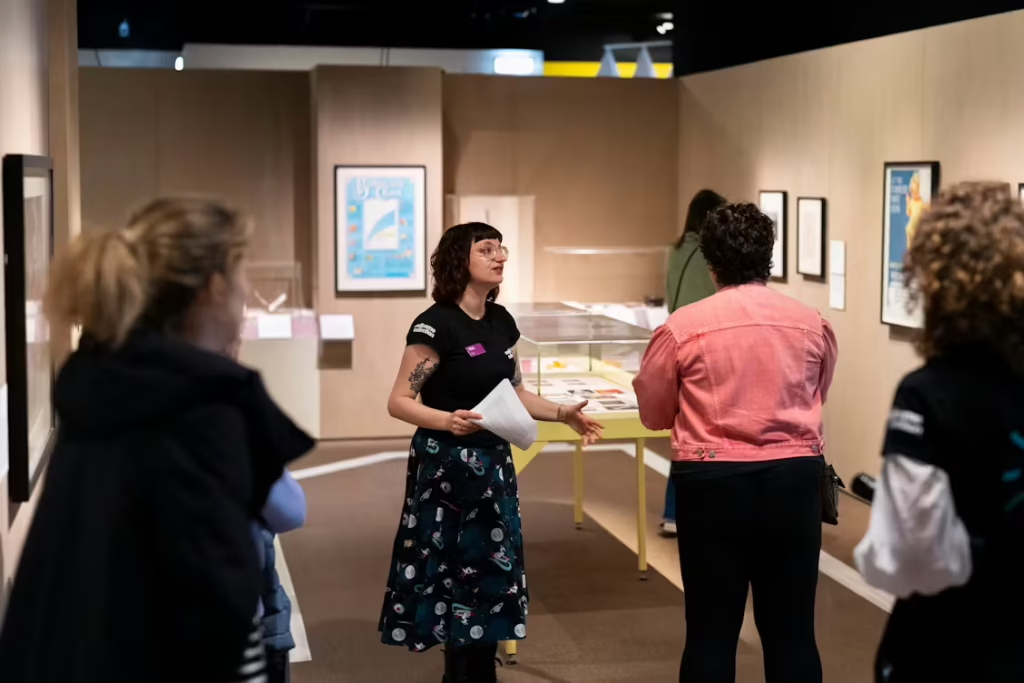
Working with External Partners – Industry/Community-based Projects
external partners, group, online learners, problem-based learning, project-based learning, work-based learningWhat are industry/community-based projects? External partners are organisations outside the university. These may be businesses or other organisations such as charities (service-based learning). Working on industry or community-based projects with these organisations give learners the experience of real-life projects in…